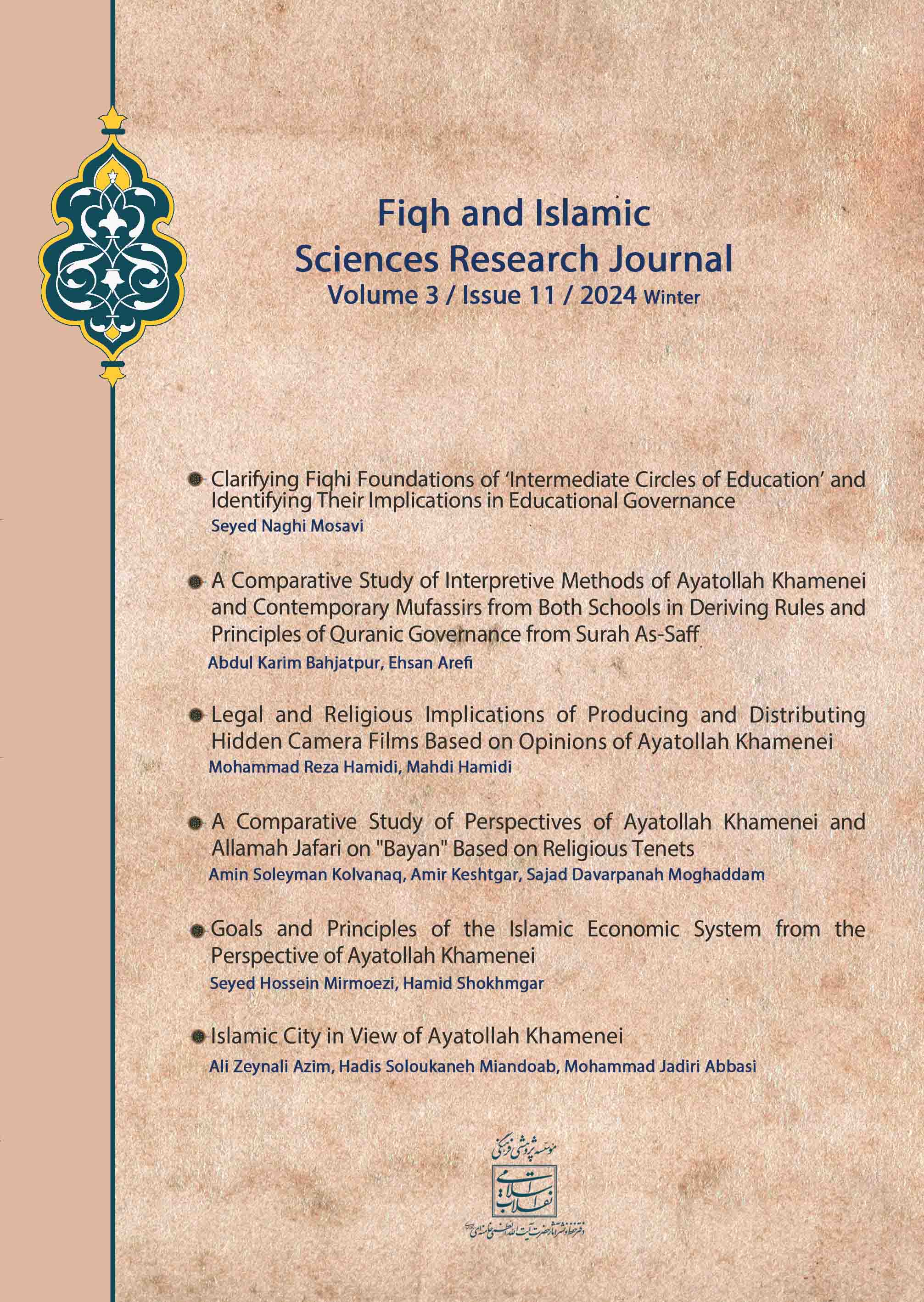
The idea of "intermediate circles" in the perspective of Ayatollah Seyed Ali Khamenei refers to the mediating activism of elite grassroots groups in moving towards a young and Hezbollahi government. This idea, either literally or contextually, also encompasses the field of education as "intermediate circles of education”. The issue addressed in this paper is the explanation and justification of the Fiqhi foundations of the idea of "intermediate circles of education" and the derivation of its implications for educational governance. Employing a descriptive-inferential-deductive methodology, the research yields the following key findings: "Intermediate circles of education" advocate for the formation and nurturing of revolutionary grassroots and youth groups to act in the field of education; Based on seven Fiqhi arguments—some addressing the educational duties of the government, some addressing the educational responsibilities of the masses, and others addressing the "mediating role of educational activism"—the "intermediate circles of education" are deemed religiously desirable, either as recommended (mustahabb) or obligatory (wajib); This idea points to a grassroots model of "sharing educational authority" and educational governance, which differs from competing models that reduce the popularization of knowledge and education to privatization and commodification. In schooling, it can serve as a foundation for a "school-centered approach," where the participation of the community, family, mosque, and NGOs is central.
Mosavi,S N . (2024). Clarifying Fiqhi Foundations of ‘Intermediate Circles of Education’ and Identifying Their Implications in Educational Governance. Research Journal on Fiqh and Islamic Sciences, 3(11), 1-16. doi: 10.22034/rjfis.2025.494373.1122
MLA
Mosavi,S N . "Clarifying Fiqhi Foundations of ‘Intermediate Circles of Education’ and Identifying Their Implications in Educational Governance", Research Journal on Fiqh and Islamic Sciences, 3, 11, 2024, 1-16. doi: 10.22034/rjfis.2025.494373.1122
HARVARD
Mosavi S N. (2024). 'Clarifying Fiqhi Foundations of ‘Intermediate Circles of Education’ and Identifying Their Implications in Educational Governance', Research Journal on Fiqh and Islamic Sciences, 3(11), pp. 1-16. doi: 10.22034/rjfis.2025.494373.1122
CHICAGO
S N Mosavi, "Clarifying Fiqhi Foundations of ‘Intermediate Circles of Education’ and Identifying Their Implications in Educational Governance," Research Journal on Fiqh and Islamic Sciences, 3 11 (2024): 1-16, doi: 10.22034/rjfis.2025.494373.1122
VANCOUVER
Mosavi S N. Clarifying Fiqhi Foundations of ‘Intermediate Circles of Education’ and Identifying Their Implications in Educational Governance. Research Journal on Fiqh and Islamic Sciences. 2024;3(11):1-16 (In Persian). doi: 10.22034/rjfis.2025.494373.1122